



IPTV is one of the most searched and most misunderstood terms in television. People use it for a technology, for a subscription, for an app and, wrongly, for a playlist file. This page separates those meanings. It explains what IPTV is, how a channel travels from the broadcaster to your screen, how IPTV differs from OTT streaming, which technical terms you will run into and what you need at home to watch it.
01
What is IPTV? A definition that holds up
IPTV stands for Internet Protocol Television. The International Telecommunication Union (ITU-T) defines it as multimedia services such as television, video, audio, text, graphics and data that are delivered over IP-based networks and managed to support a required level of quality of service and experience, security, interactivity and reliability.
Two parts of that definition matter in everyday life. First, IPTV is a delivery method: the same channels you know from cable arrive as IP packets, and it is the network, not the programme, that changes. Second, the words "managed" and "quality" point at the original idea: an operator controls the path so that live television stays smooth.
In daily speech the word has stretched well beyond that definition. It now also covers live-TV apps that run over any internet connection, and, often incorrectly, simply a list of channel addresses. Knowing which meaning is in play saves you from buying the wrong thing.

02
How does IPTV work? From the channel to your screen
The route is the same whether you use an operator box or a streaming app. These are the stages a live channel passes through:
- Contribution: the broadcaster delivers the programme feed to the provider, usually over a dedicated link
- Encoding: the provider compresses the video with a codec such as H.264 or H.265 so that it fits through a normal internet line
- Packaging: the compressed stream is wrapped in a container and cut into packets or short segments
- Rights protection: licensed services usually encrypt the stream with a DRM system, so only paying, authorised devices can play it
- Middleware: a platform keeps the channel list, the programme guide (EPG), user accounts and entitlements
- Delivery: the packets travel across the operator's managed network or through content delivery servers on the open internet
- Playback: the box, smart TV or app on your side decodes the stream and shows picture and sound
- Return channel: pressing pause, replay or record sends a request back to the provider, which holds those functions on its servers
03
Managed IPTV or OTT streaming: the difference that matters
Strictly speaking, IPTV in the ITU sense runs on a managed network. Services delivered over the open internet are called OTT ("over the top"), because they travel on top of someone else's connection. The two are often sold together and look the same on the screen, but they behave differently:
| Aspect | Managed IPTV | OTT live TV |
|---|---|---|
| Network | Provider's own managed network, usually with its own box | Open internet, any connection |
| Typical delivery | Multicast or other controlled streaming inside the network | Adaptive HTTP streaming such as HLS or MPEG-DASH |
| Quality control | The operator controls the whole path | Depends on your line; the player adjusts quality to available speed |
| Delay behind the live broadcast | Usually small | Often several seconds, sometimes more |
| Devices | Often the provider's box, plus apps | Apps on smart TVs, sticks, phones, browsers |
| Contract | Frequently tied to an internet or mobile plan | Often cancellable month to month |
04
IPTV streaming and the IPTV stream: what the words mean
An IPTV stream is the continuous flow of data that carries one channel. "IPTV streaming" is the act of receiving and playing it. The stream is not a file you download first: the player decodes it while it arrives and keeps only a few seconds of buffer.
Many OTT services use HTTP Live Streaming (HLS), described in RFC 8216. HLS cuts the stream into short media segments and lists them in a playlist file that the player re-reads. Because the player always works a few segments behind, such streams run behind the live broadcast. Managed IPTV networks often use RTP (RFC 3550) instead, a transport protocol built for real-time media, which keeps the delay shorter.
05
Technical terms you will meet, explained
Providers, forums and app stores use a lot of shorthand. This table translates the most common terms:
| Term | What it means | Where you meet it |
|---|---|---|
| EPG | Electronic programme guide: the schedule shown on screen | Every proper TV service; missing or wrong in many unlicensed lists |
| Multicast | One copy of a channel is sent into the network and copied only toward households that are watching | Operator networks |
| HLS and MPEG-DASH | Ways of delivering live video as short segments over HTTP, adjusting quality as speed changes | OTT apps and web players |
| H.264 and H.265 | Video codecs that compress the picture; H.265 needs less data for the same quality | Provider specifications and device lists |
| DRM | Encryption that ties playback to authorised devices | Licensed services |
| Replay and catch-up | Watching a programme that already aired, up to a time limit | Operator plans, Zattoo, SRG players |
| Restart and live pause | Starting a running programme from the beginning, or pausing live TV | Zattoo and operator apps |
| Network recording | Recordings stored on the provider's servers, not on a box at home | Swisscom, Sunrise, Salt recordings |
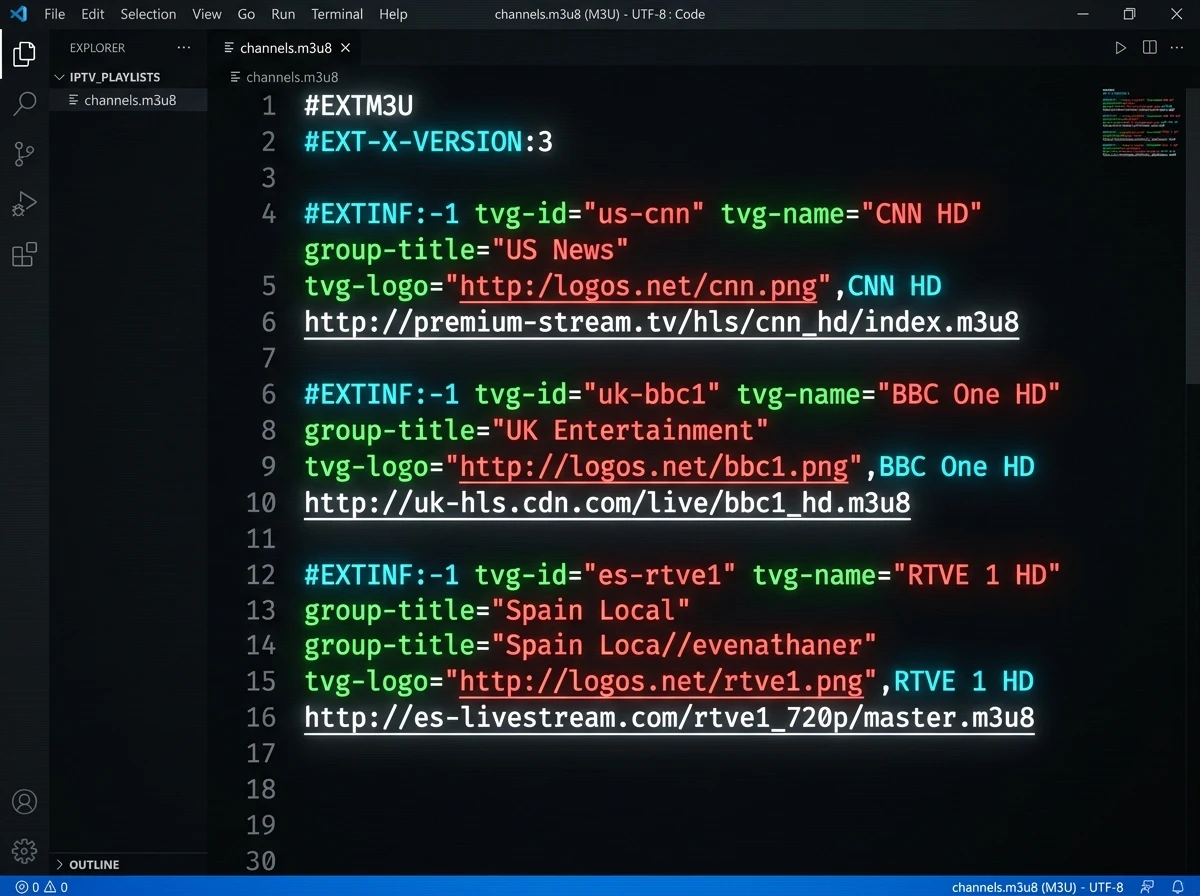
| M3U / M3U8 | A text file that lists stream addresses | Players that load a channel list |
06
IPTV server: what runs behind the stream
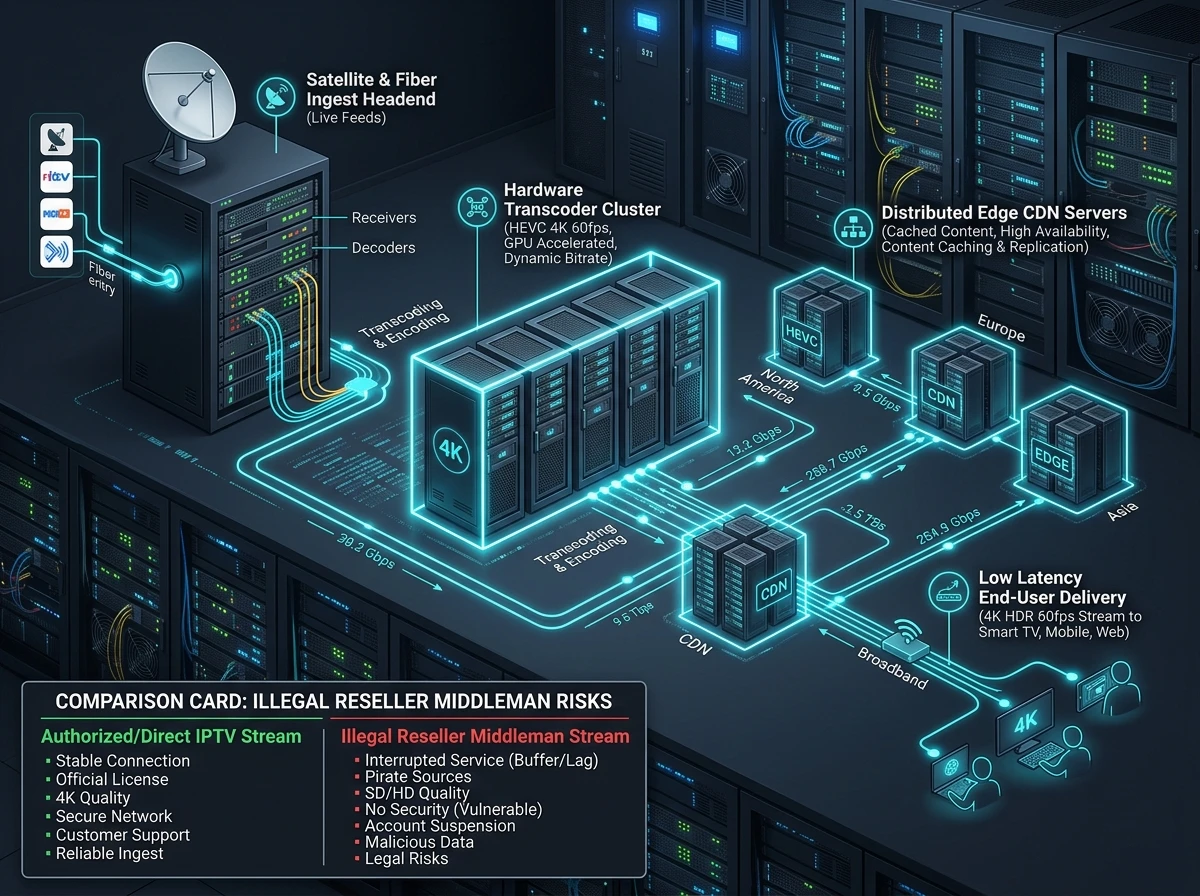
When people say "IPTV server" they mean the equipment on the provider's side: encoders that compress the incoming channels, a packaging and rights layer, the middleware with accounts and the programme guide, and delivery servers that push the streams out. Operators run this at scale with redundancy, monitoring and licences for every channel they carry.
The server is also where the legal line is drawn. Running the infrastructure for channels one holds rights to is ordinary broadcasting business. Running it to pass on other people's channels without the rights is what Swiss copyright law targets; see IPTV illegal or legal in Switzerland.
07
What you need to watch IPTV at home
Four ingredients are enough:
- A service: a subscription or free offer that holds the rights to the channels. The software cannot replace this
- A player: the operator's box, or an app on a smart TV, streaming stick, tablet or phone (see IPTV apps and players)
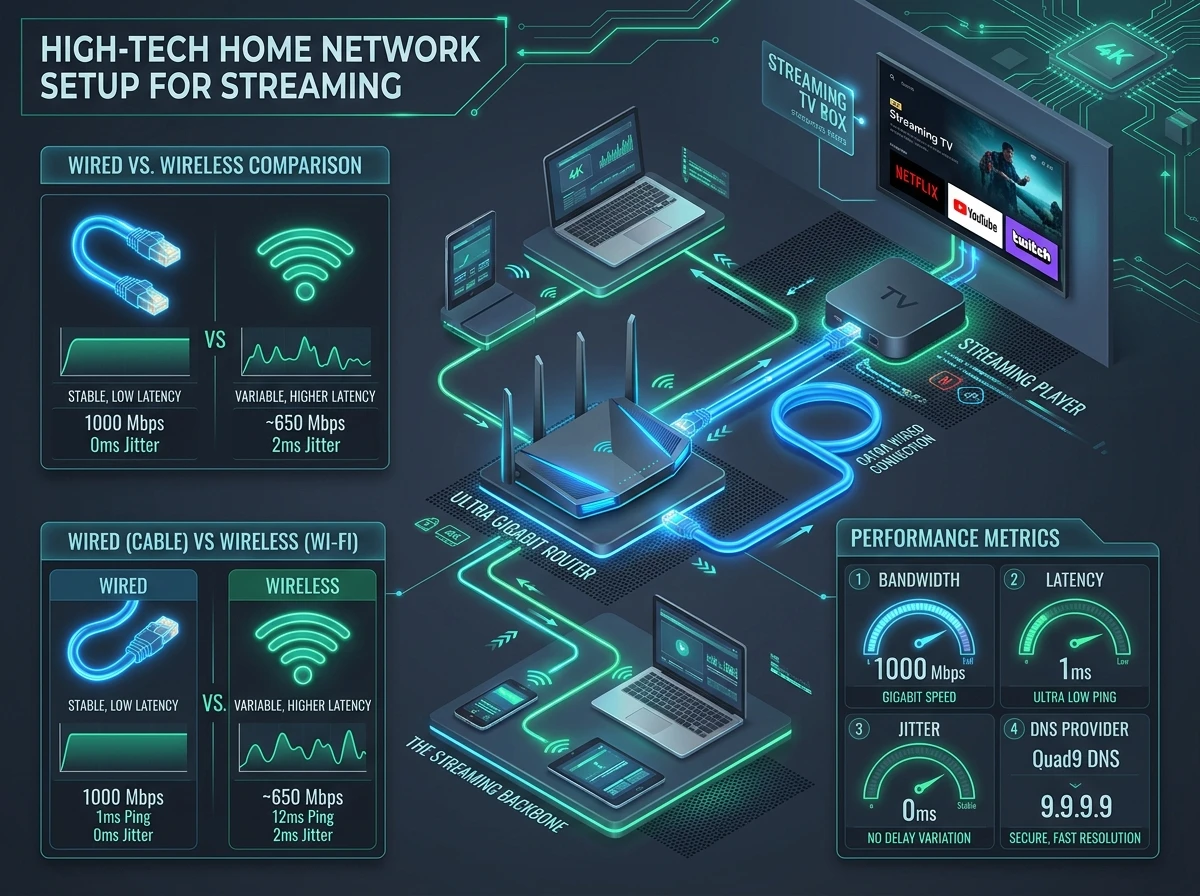
- A stable connection: a Full HD stream needs roughly 8 Mbit/s, and several viewers add up. Stability counts for more than peak speed
08
IPTV is not a provider, a playlist or a free channel list
Four common mix-ups are worth clearing up:
- IPTV is a technology, not a company. Swisscom blue TV, Sunrise TV, Salt TV and Zattoo are services that use it
- An IPTV app contains no channels. Players are neutral software that load whatever source you give them; how that works is covered in IPTV playlists and M3U files
- A low price does not make IPTV free. Free and lawful TV exists, but it comes from broadcasters and licensed services, not from lists of unlicensed streams
- IPTV is not automatically illegal. Licensed IPTV is the normal way many households watch television
09
Is IPTV legal?
The technology is lawful everywhere. What counts is whether the provider holds the broadcasting rights for the channels it sends. In Switzerland, operating or reselling channels without those rights is punishable under the copyright act, while private viewing is treated differently; the details are in IPTV illegal or legal in Switzerland. For the licensed Swiss services, their prices and the speeds they need, start with IPTV Switzerland.
FAQ
Frequently asked questions
What does IPTV stand for?
Internet Protocol Television. It means television delivered as data packets over an IP network instead of a broadcast, cable or satellite signal.
How does IPTV work?
The provider compresses and packages the channel, protects it with encryption, and sends it over its network or the open internet. A box or app on your side decodes it. Replay, pause and recordings are stored on the provider's servers.
What is the difference between IPTV and OTT?
Managed IPTV runs on the operator's controlled network, often with its own box. OTT live TV travels over the open internet and works on any connection. Both can look identical on screen.
What is an IPTV stream?
It is the continuous data flow that carries one TV channel. The player decodes it while it arrives and keeps only a short buffer, rather than downloading a file first.
Is IPTV the same as streaming?
IPTV is one kind of streaming: linear television with a channel list. Services such as Netflix stream on-demand content, with no channel schedule.
Do I need a special box for IPTV?
Not necessarily. Many services run as apps on smart TVs, streaming sticks, phones and browsers. Operators often provide their own box.
What internet speed does IPTV need?
A Full HD stream needs roughly 8 Mbit/s, HD about 5 and SD about 3 Mbit/s, according to Zattoo. Simultaneous streams and other household use add up.
Why is my IPTV stream behind live?
Segment-based internet streams such as HLS work a few segments behind the live broadcast, so a delay of several seconds is normal. A network cable instead of Wi-Fi helps with buffering but not with this delay.
What is an IPTV server?
The provider's equipment that encodes, packages, protects and delivers the channels, together with the middleware that handles accounts and the programme guide.
Is IPTV legal?
The technology is. A service is lawful if it holds the rights to the channels it carries. Unlicensed services are not, however they are delivered.
Sources
- ITU-T: IPTV definition (IPTV Joint Coordination Activity, terms of reference)
- ITU-T Recommendation Y.1901: requirements for the support of IPTV services
- RFC 8216: HTTP Live Streaming
- RFC 3550: RTP, a transport protocol for real-time applications
- ITU-T Recommendation H.264: advanced video coding
- ITU-T Recommendation H.265: high efficiency video coding
- Zattoo support: minimum requirements and resolution
Read next
- IPTV Switzerland: licensed providers comparedSwisscom, Sunrise, Salt and Zattoo with prices and speeds
- IPTV illegal or legal in SwitzerlandWhat the copyright act says for viewers and providers
- IPTV apps and players comparedWhich player runs on which device
- IPTV playlists and M3U filesWhat a playlist is and what it is not
- IPTV devices: box, stick or Smart TVWhich hardware suits which setup
More from the blog
- Technology4 min readIPTV glossaryIPTV glossary with 50 terms explained in one line each: EPG, M3U, Xtream Codes, HLS, RTP, codecs, DRM, STB, replay, OTT and more, with sources.
- Technology2 min readWhy live streams lag behind TVWhy a live TV stream runs seconds behind the broadcast: segments, buffers, encoding and managed networks explained, and what you can and cannot change.
- Technology3 min readInternet speed for TV streamingHow many Mbit/s TV streaming needs: per-stream figures from Zattoo and Netflix, Swisscom's 40 Mbit/s for UHD, data per hour and worked home examples.