




"IPTV illegal" and "fine" are the searches behind this page, and Swiss law answers them in two parts: one for people who watch, one for people who run or resell channels. This page keeps the two apart, cites the articles of the Copyright Act, relies on the Swiss Federal Institute of Intellectual Property (IGE) and says plainly what the law does not spell out. It is general information, not legal advice.
01
IPTV illegal or legal? The answer in one table
What is allowed depends less on the technology than on who does what with the channels. The table classifies the most common situations; the sections below explain each row.
| Situation | Assessment | Basis |
|---|---|---|
| Using IPTV technology, a box, an app or a stick | Legal. The technology is neutral. | The CopA regulates works, not the transmission technology |
| Subscribing to a provider that holds the rights | Legal. | The provider has acquired the rights |
| Watching privately, even a service without a licence | Permitted for the viewer and, per the IGE, not criminally prosecutable, but with practical risks. | Art. 19 CopA; IGE interpretation |
| Passing on access, uploading or restreaming | Prohibited. | Art. 10 para. 2 let. c CopA |
| Running or retransmitting channels without a licence | Punishable; for commercial gain up to five years in custody. | Art. 10 para. 2 let. e, Art. 67 para. 1 let. h and para. 2, Art. 69 CopA |
| Reselling access to unlicensed services | High criminal risk: taking part in the chain of distribution. | Art. 67 and 69 CopA, participation under the Criminal Code, Art. 62 CopA |
| Circumventing a technical protection or encryption | Prohibited; fine on complaint, with an exception for lawful uses. | Art. 39a and 69a CopA |
02
Is IPTV legal in Switzerland? What the Copyright Act says
The Copyright Act (CopA) does not contain the word "IPTV". It regulates who may use a protected work, here a television broadcast. The path the signal takes to you does not matter; what matters is whether the operator holds the rights to the channels.
For viewers, Article 19 CopA is the central rule: published works may be used for private use. That covers any personal use and use within a circle of persons closely connected to each other, such as relatives or friends (Art. 19 para. 1 let. a). From this the IGE concludes that downloading or streaming for private use is allowed, expressly including from illegal sources.
That last point needs precision, because it is not in the text of the law. The IGE itself writes that it is not explicitly stated in the law but appears to be undisputed nowadays. It is an established interpretation, not a statutory sentence. The IGE also states that the revision of the CopA in force since 1 April 2020 targets pirate providers and hosting providers; nothing changes for consumers of illegal content.
The position is clearer for licensed offers: copies made by accessing works that are lawfully made available are excluded from the restrictions on private use (Art. 19 para. 3bis CopA).
03
Uploading and sharing: where private use ends
Private use protects watching, not distributing. The IGE is explicit that uploading is never lawful private use, not even on a personal website or in a file-sharing network, and regardless of whether you make a profit.
For IPTV that means: handing your login to strangers, restreaming a channel through your own server, or uploading while you watch through a torrent makes works available to others. That right belongs exclusively to the rights holders under Art. 10 para. 2 let. c CopA. Exactly where the "circle of persons closely connected to each other" ends is decided by a court in a dispute; offering access publicly or commercially is clearly outside it.
Enforcement also starts here. According to the IGE, rights holders may log the IP addresses of uploaders in order to submit them with a criminal complaint. For people who only download for private use, which cannot be criminally prosecuted, logging IP addresses is not permitted.
04
IPTV illegal: which penalties do providers and resellers face?
Anyone who wilfully and unlawfully broadcasts a work by radio, television or similar means, including by wire, or retransmits a broadcast work by technical equipment whose operator is not the original broadcasting organisation, is liable under Art. 67 para. 1 let. h CopA. That describes a person who feeds channels to customers without a licence. The base penalty is a custodial sentence of up to one year or a monetary penalty, on the complaint of the injured party.
If the act is committed for commercial gain, the offence is prosecuted ex officio. The penalty is a custodial sentence of up to five years or a monetary penalty, and a custodial sentence must be combined with a monetary penalty (Art. 67 para. 2 CopA). Broadcasting organisations have related rights of their own: retransmitting a broadcast carries the same penalties under Art. 69 para. 1 let. g CopA. In commercial cases the IGE gives the maximum monetary penalty as CHF 540,000.
A 2020 case shows how seriously the authorities treat this. At the request of Switzerland, led by the Public Prosecutor's Office of the canton of Vaud and the Cybercrime Division of the Police de Sûreté, Eurojust and Europol coordinated an action against the illegal sale of boxes for series and films used in more than 20,000 households. Three suspects were arrested, eight Swiss bank accounts seized and eleven servers shut down across five countries.
On the civil side, rights holders can also ask a court to prohibit an infringement, remedy it and require information (Art. 62 para. 1 CopA), and claim damages under the Code of Obligations (Art. 62 para. 2 CopA). Figures for "IPTV fines" that circulate online are mostly from other countries; ask for the source.
05
IPTV illegal: what actually awaits viewers
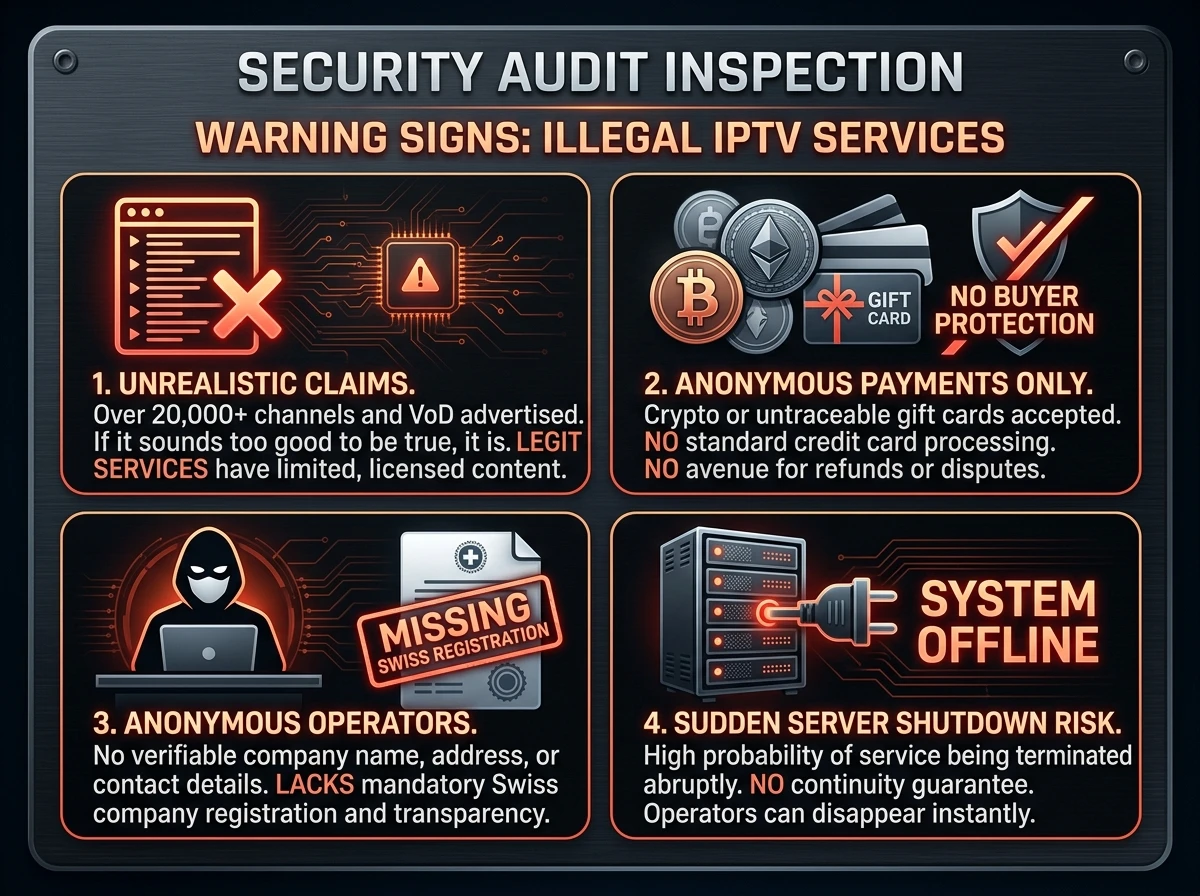
On the legal position described, for viewers the problem is not criminal law but the business model of the service. The CopA contains a fine in one nearby case: Art. 69a, which concerns wilfully circumventing a technical protection in order to make an unauthorised use. Someone who uses a service without a licence mainly risks:
- A shutdown without warning: rights holders act against servers and operators, and prepaid time is lost
- No support and no refund, because there is often no reachable counterparty
- Misuse of payment and login data handed to an anonymous operator
- Modified apps or boxes from unofficial sources
06
You paid for a service without a licence: what now?
If you discover that a service you paid for had no rights, act in this order: stop recurring payments, ask your card issuer about a chargeback if you paid by card, change any password you reused elsewhere, remove unknown apps and boxes and switch to an offer with verifiable licences.
Which licensed offers exist is shown in IPTV Switzerland; what the plans on this site cost is on the IPTV pricing in Switzerland page.
07
Is an IPTV subscription legal? Boxes, apps and subscriptions
A subscription is legal if the provider holds the rights to its channels. That is the case with Swisscom blue TV, Sunrise TV, Salt TV and licensed OTT services such as Zattoo.
Hardware and software are neutral: an IPTV box, a streaming stick or a player app is ordinary electronics or software, including the well-known players. What you feed into them determines the legal assessment. The guide to IPTV apps and players explains what such software does and does not contain.
Devices sold with preconfigured access to unlicensed services are different. In 2017, in the Filmspeler case (C-527/15), the Court of Justice of the European Union held that selling a player with add-ons preinstalled that link to unauthorised streams is a communication to the public. The ruling does not bind Switzerland, but it shows the direction of the assessment.
08
Three questions before you buy
Before paying, three questions clarify the position:
- Who is your counterparty? Serious operators state their company name, address and registration number. Swiss companies can be looked up in Zefix, the Swiss central business name index
- Where do the broadcasting rights come from? A provider should be able to say from whom it obtains rights or licences
- Is the price plausible? If it is far from what comparable licensed offers cost, that is a reason to ask for the licences
09
Is free IPTV legal?
It depends only on the source. The catch-up libraries of SRF, RTS and RSI, advertising-funded live streams and the free tiers of licensed services are legal and free. Lists and "free codes" for pay channels, by contrast, mostly distribute channels without rights, even though they cost nothing.
10
Does a VPN change anything?
A VPN changes who can see your traffic, not whether a service holds the broadcasting rights. It does not make an unlicensed service lawful, and it does not change the rules on uploading. With a licensed service, its terms may restrict use outside the licensed territory, so read them before relying on a VPN to get around location limits.
11
Switzerland, the EU and Italy: where viewers are treated differently
If you live near a border or move between countries, remember that the rule depends on where you are. Much confusion comes from foreign rules being applied to Switzerland. The differences mainly concern viewers; for providers the position is serious everywhere.
| Country or area | Viewers | Providers and sellers |
|---|---|---|
| Switzerland | Private streaming and downloading permitted, even from an unlicensed source (IGE interpretation); uploading prohibited | Punishable under Art. 67 and 69 CopA |
| EU (CJEU 2017) | Streaming from a manifestly unlawful source is not covered by the exception for temporary copies; sanctions are for member states | Selling preconfigured players is a communication to the public |
| Italy | Since Law 93/2023 users can also be fined; reported fines start at EUR 154, with the first wave in 2025 | Punishable |
12
Status of the law, sources and limits of this page
The provisions cited refer to the English translation of the CopA on Fedlex as of 1 January 2022; the IGE statements were consulted in October 2026. The English translation has no legal force: only the German, French and Italian texts are authentic. Laws change, so always check the current version on fedlex.admin.ch. The statements on Italy rest on press reports and those on the CJEU on the text of the judgment.
This page summarises the general position for a non-legal audience. It is not legal advice and does not consider your individual case. For a concrete question, for example after a letter from rights holders, the right contact is a lawyer who specialises in intellectual property.
FAQ
Frequently asked questions
Is IPTV legal in Switzerland?
Yes. IPTV is only a delivery method, and Swisscom, Sunrise, Salt and Zattoo use it themselves. What is prohibited is distributing channels without the necessary rights, not the technology.
Can you be punished for watching IPTV in Switzerland?
Operators and resellers of unlicensed services can be punished under Art. 67 and 69 CopA, for commercial gain with up to five years in custody. For pure private viewing the IGE treats private use as permitted; uploading or passing on access is prohibited.
What happens if you are caught with illegal IPTV?
For viewers the likeliest consequences are practical: the service is shut down, prepaid time is lost and payment data sits with an anonymous operator. Proceedings in practice concern operators and sellers.
What is the penalty for illegal IPTV in Switzerland?
Art. 67 para. 1 CopA provides for a custodial sentence of up to one year or a monetary penalty, on complaint. For commercial gain it is up to five years in custody, combined with a monetary penalty, and prosecution is ex officio.
Is an IPTV subscription legal or illegal?
It is legal if the provider holds the rights. That is the case with Swisscom blue TV, Sunrise TV, Salt TV and licensed OTT services.
Is it legal to buy an IPTV box or app?
Yes. Boxes, sticks and player apps are neutral products. Only devices sold with preconfigured access to unlicensed services are problematic.
Is free IPTV legal?
Catch-up libraries, advertising-funded live streams and the free tiers of licensed services are. Lists and codes for pay channels mostly distribute channels without rights, although they cost nothing.
Is it the same in Italy or the EU as in Switzerland?
Not for viewers. In Italy users can also be fined since 2023, and for the EU the CJEU held in 2017 that streaming from a manifestly unlawful source is not covered by the exception for temporary copies.
Can my provider or a rights holder see that I use IPTV?
Technically your internet provider sees which servers you connect to. According to the IGE, rights holders may log the IP addresses of uploaders only, not of people who just download or watch.
What is the difference between streaming and uploading?
Streaming receives a work and is covered by private use. Uploading or restreaming makes it available to others, which Art. 10 para. 2 let. c CopA reserves to rights holders. A torrent does both at once.
Sources
- Copyright Act (CopA, SR 231.1), English translation, Fedlex
- IGE: copyright on the internet
- IGE: revision of copyright law, the key reforms
- IGE: counterfeiting and piracy, what does the law say?
- Eurojust, 10 November 2020: coordinated action against illegal online streaming in Switzerland
- CJEU, judgment of 26 April 2017, C-527/15 (Filmspeler)
- TorrentFreak, May 2025: Italy fines over 2,200 pirate IPTV subscribers
Read next
More from the blog
- Law3 min readCopyright revision 2020What the Swiss copyright revision of April 2020 changed for streaming and piracy: stay-down for hosts, IP logging, and what stayed the same for viewers.
- Safety3 min readIPTV scams and red flagsIPTV scams in Switzerland: how fake sellers, reseller panels and "lifetime" deals work, the red flags to check before paying and what to do if you paid.
- Living in Switzerland3 min readSwiss TV abroadCan you watch Swiss TV abroad? SRF live streams are blocked outside Switzerland, Zattoo allows 90 days per trip but only recordings on a Swiss account.